
How to weave AI into your organisation’s DNA
The most common conversation we have with CEOs about AI right now starts with a question that misses the point. "What's our AI strategy?" The instinct is to commission one, usually through the CIO or CDO, layer it onto a roadmap, allocate a budget, and announce it. Six months later, the strategy exists. The organisation is no different.
AI doesn't bolt onto an organisation. It weaves through it, or it doesn't. The technology is the easy part. The system around it, how decisions are made, where judgement sits, which work matters, what gets measured, who is trusted to lead, is the work. Organisations that have already built clarity, decisive leadership and execution capability find that AI compounds those qualities into something genuinely new. Organisations that haven't find that AI exposes every weakness they already had, and faster.
The frame that matters is not technological, it is organisational. AI is a thread that runs through everything an organisation does, or fails to do. To drive value from AI, organisations must weave it into their DNA.
Where to look first
Before commissioning an AI strategy, there are three places to look. All three are sitting in plain sight and most executive teams aren't looking.
The first is shadow AI. Inside the organisation, your workforce is already using AI, off-grid, without policy, without oversight, often without your knowledge. Consider a private-equity-owned business with no formal AI position. The executive team is debating where to "start" with AI. Meanwhile, the finance team is building models using Claude Code, marketing has standing arrangements with three different generative tools, and sales has been using AI-built proposals for nine months. The organisation has already adopted AI. The question is whether it is doing so safely, consistently, and with any sense of shared direction. A shadow AI audit is the cheapest, fastest, most useful diagnostic available to most executive teams. Few run one.
The second is customer AI. Outside the perimeter, your customers are using AI to research, compare, recommend, and decide. Brand visibility, search behaviour, product comparison, even pricing intelligence, all of it is being mediated through AI before a customer ever touches your channels. Consider a retailer drowning in internal AI options, debating which platform to pilot, while its customers are quietly being steered toward competitors by recommendation engines the retailer has no visibility into. The strategic question is no longer just "how do we use AI internally" but "how does AI describe us externally, and are we shaped to be found."
The third is money already leaking on the P&L. AI's most defensible business case sits in cost lines that are slow, manual, error-prone, repeatedly outsourced or repeatedly redone. Consider a FTSE 100 where the AI conversation has been captured by the CIO and CDO, who are designing an enterprise architecture twelve months out. The executive team is waiting for the architecture. Meanwhile two operational departments are losing the equivalent of nine FTE a year to rework, and AI could materially fix it within a quarter. The architecture matters. The leaking P&L matters more.
These three places, shadow, customer, money, are where the real AI diagnostic lives. They tell you what your organisation has already done, what is happening to it whether it acts or not, and where the return is most credible. Strategy follows the diagnostic, not the other way around.
What AI exposes
Once an organisation starts to take AI seriously, it discovers that AI is not a separate transformation. It is a stress test on the transformation already in progress. This reframe matters more than any single AI decision an executive team will make. Treat AI as a solution looking for problems and you layer complexity onto an unreformed operating model. More initiatives, more noise, less execution. Treat AI as a stress test instead, and the question reorganises. What are we trying to achieve, where are the real constraints, how should we be organised, and given that, where does AI genuinely help. AI is then an enabler, not a solution. It raises the bar for leadership. It does not lower it.
The stress test applies pressure along the three lines that always determine whether transformation actually lands: clarity, connection, and commitment. We see it in almost every leadership team we work with.
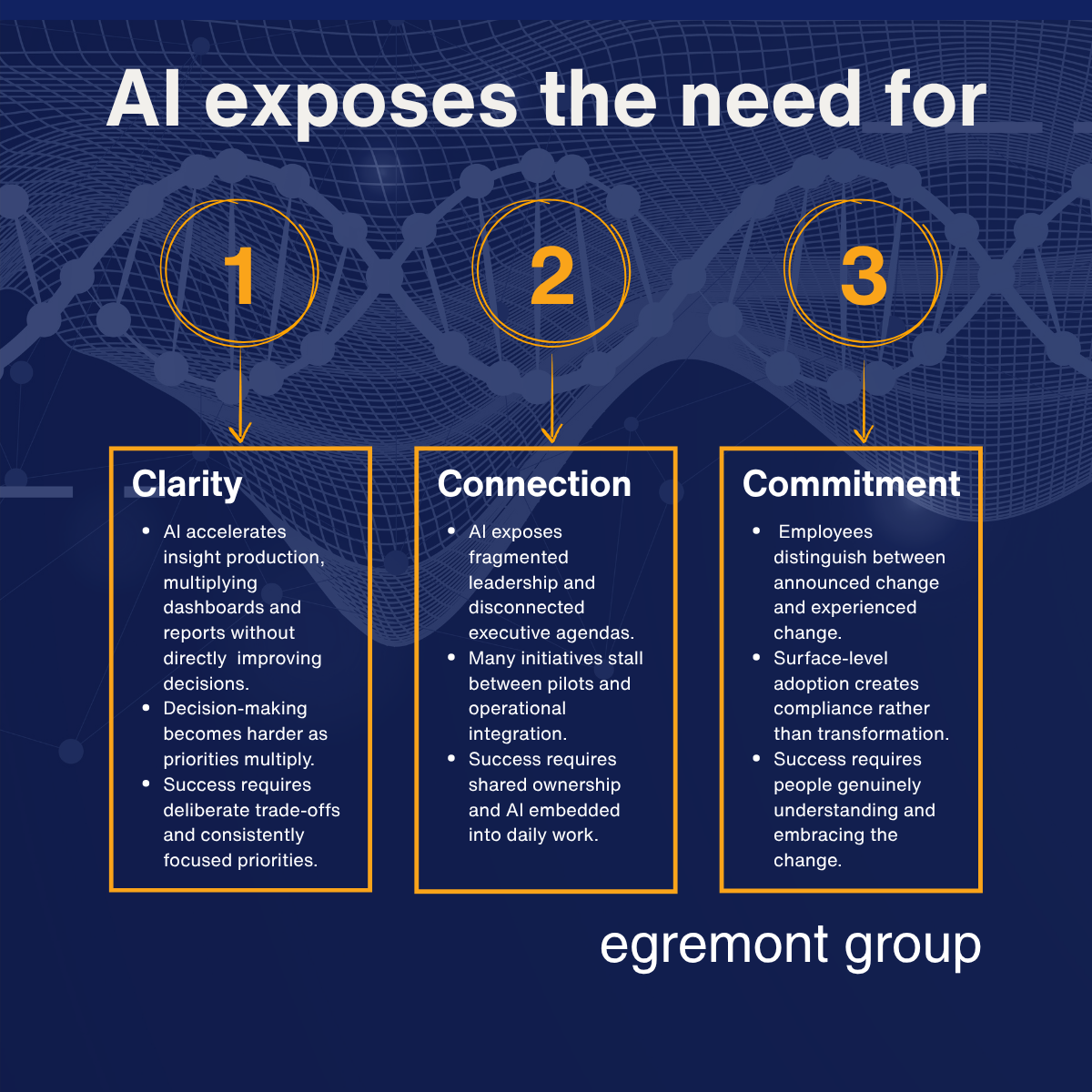
Clarity. Senior leaders are already drowning in data and competing demands. AI accelerates the production of insight - dashboards multiply and reports lengthen. Decision-making does not become easier, it becomes harder. AI exposes whether the trade-offs in the organisation are being made on purpose or by accident. The trap is cognitive overload. The breakthrough is trade-offs by design, the few priorities held consistently under pressure. Without clarity, AI is a noise multiplier.
Connection. This is where most transformations fail, and where AI applies the most pressure. It tests connection in two places.
The first is between the leaders themselves. Most executive teams operate as a federation of capable individuals, each accountable for their own domain, meeting periodically to exchange information. In a federation, AI gets allocated. It becomes the CIO's project, the CDO's project, the COO's experiment. The collective question of what kind of organisation we want AI to help us become is rarely asked. The trap is the federation. The breakthrough is a shared executive agenda, owned by the team rather than parcelled across it.
The second is between the leaders and the work. AI initiatives launch easily. They stall in the difficult middle, after the proof of concept lands and before the operating model has been redesigned to absorb what AI changes. Middle managers, already functioning as the compressed compensating mechanism of most large organisations, are asked to deliver AI adoption while keeping the day job running. They are the people who decide, in practice, whether AI weaves into the work or stays bolted on. The trap is the difficult middle. The breakthrough is AI woven into the work, with the middle genuinely supported and the operating model redesigned around what AI changes.
Commitment. People who have been through transformation programmes before are sceptical of slogans, frameworks and launch events. They have learned the difference between change that is announced and change that is felt. AI either becomes part of how the organisation thinks and decides, or it becomes another initiative the workforce waits out. The shift from "I know" to "I understand" to "I care" applies to AI as much as to any other change. The trap is surface adoption. The breakthrough is adoption that is felt at every level, not announced from the top. Mandated adoption produces compliance. Genuine adoption requires people to think their own way into the change.
How AI pays back
The return on AI is most credible when it is connected to the three gaps that govern any transformation: capacity, capability, and culture. We describe the arc as Get Fit, Go Faster, Get Stronger. AI accelerates each one if the organisation is ready for it.
Get Fit is the capacity gap. The work that needs to be done versus the work that gets done. Most organisations are carrying a significant volume of low-value work, manual, repetitive, duplicative, that crowds out the work that actually matters. AI is well suited to releasing that capacity. Consider a water utility whose transformation keeps slipping. Investment is in place, the operating model has been redesigned, the strategy is clear. Execution is stuck because middle leaders and frontline teams are drowning in administrative load, regulatory reporting, handover paperwork, incident triage, schedule reconciliation. AI applied at the right points in that operation does not replace people. It takes the load off, and gives them back the bandwidth to lead the change they were asked to lead. Get Fit means freeing the system before asking it to do more.
Go Faster is the capability gap. The judgement, decision quality and pace required by the strategy, versus what the organisation can currently produce. Once capacity is restored, the question becomes whether the organisation can think and decide better. AI augments human judgement here. It does not replace it. Consider an FMCG business running below growth plan. The strategy is sound. The category insight, customer segmentation, channel decisions, range planning, pricing response, all of it is happening too slowly. AI applied here does not produce the decisions. It compresses the time between question and answer, surfaces patterns the team would have missed, and lets capable leaders make better calls faster. The capability gap closes not because AI replaces management, but because AI raises the quality of the work management does.
Get Stronger is the culture gap. The change-readiness of the organisation versus the change-readiness the strategy requires. This is the hardest gap to close and the one most resistant to technology alone. Consider an airport managing security queues. The operational problem is acute, the customer experience consequences are visible, the regulatory pressure is real. AI can help, with predictive resourcing, real-time queue management, dynamic lane allocation. None of it lands unless the operational culture is ready to act on what the AI tells it. Get Stronger is the work of building the muscle, the trust, the routines and the leadership behaviours that turn AI insight into AI execution. It is the work that makes the change stick.
The three gaps close in sequence. Capacity unlocks capability. Capability unlocks culture. Culture is what makes the next AI wave, and the next transformation, easier than this one. As one CEO put it to us, "you mobilise change, you don't preach it." That sentence travels with us because it captures the difference between organisations that announce AI and organisations that actually become better because of it.
The work
The technology is the ‘easy’ part. The system around it is the work. Whether AI delivers anything material depends on whether the leadership team is decisive enough to choose what matters, whether the operating model is honest enough to absorb what AI changes, whether the middle of the organisation is supported enough to lead adoption rather than compensate for ambiguity, and whether the culture is strong enough to make the change stick.
That is the work we do. We are not an AI technology firm. We work side by side with leadership teams on the human side of change, the part where AI either weaves in or quietly fails to land. Twenty-five years of delivering breakthrough transformation, across more than 230 clients in 25 countries, has given us a clear view of what separates the organisations that compound from the ones that stall.
If any of this resonates, it is a conversation we are having with leadership teams across sectors right now. We would be glad to have it with yours - get in touch