
The hidden cost of holding everything at once
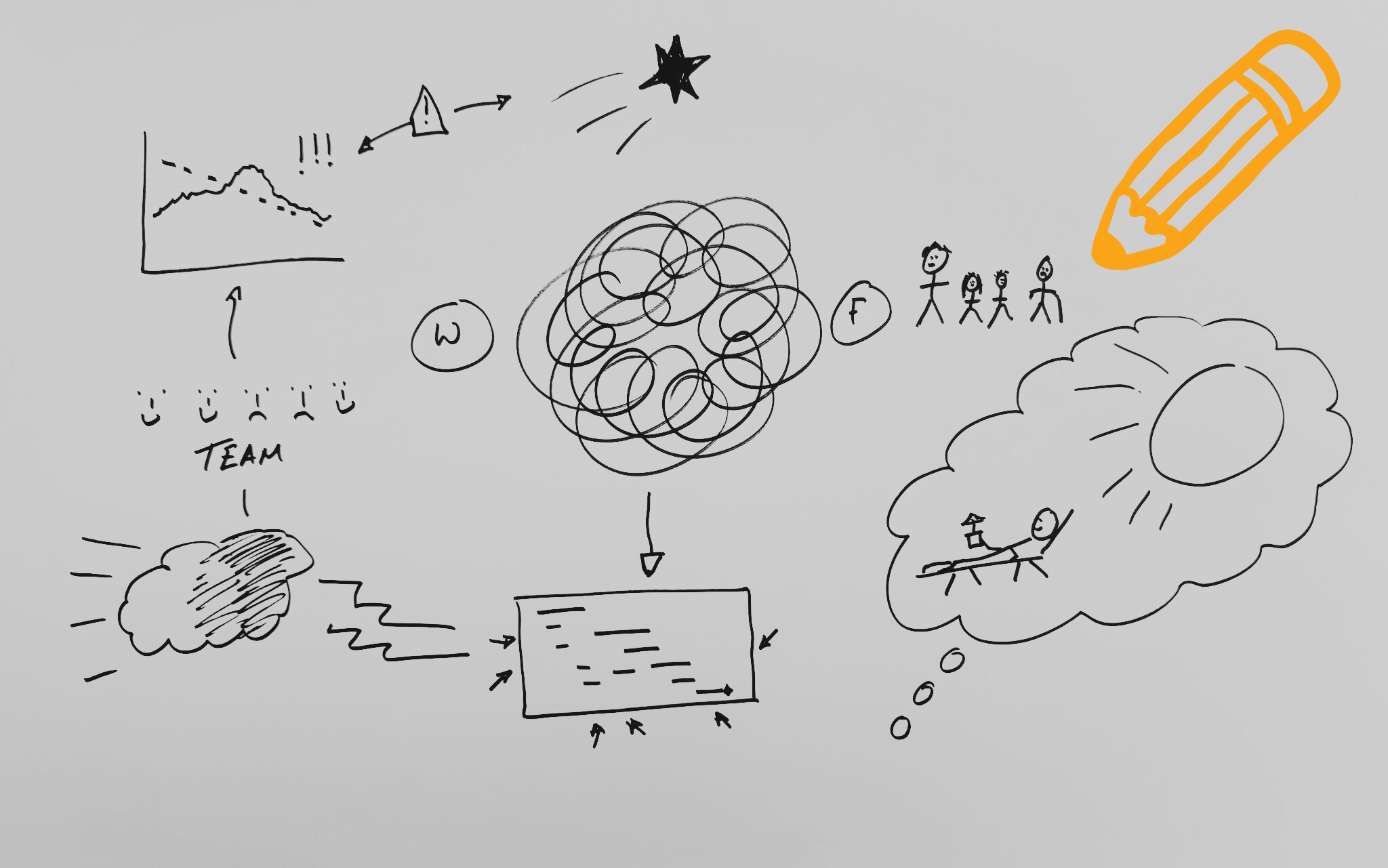
"Now I stand back, I see what I'm holding all at once. It's both cathartic and terrifying."
A senior executive said this after being asked to do something deceptively simple: draw a picture of their world.
No framework. No prompts. Just a blank page and a pen.
Over the past two years, James Clement, Partner at Egremont has used this exercise with more than a hundred CEOs, COOs and senior leadership teams, many of them leading complex transformation programmes, in this article, he shares his reflections.
‘The drawings vary in style and artistic quality. Their structure is strikingly consistent.
At the centre of almost every page is a dense swirl, arrows, loops, overlapping demands. Around the edges sit familiar pressures: cost constraint, digital transformation, AI, regulatory complexity, performance targets. Woven into the margins are personal realities, ageing parents, children, health, relationships under strain.
And somewhere, nearly every time, there is a holiday. A beach. A mountain. Somewhere that isn't this.
One drawing stays with me. It had three layers. At the top, a cloud of chaos, work and life orbiting each other without separation. Beneath it, a carefully drawn bookshelf: an attempt at order, except the books were tipping, mid-collapse. Below that, hammers falling from the sky, the unexpected demands that periodically undo whatever fragile stability has been constructed.
What struck me wasn't the chaos. It was the bookshelf. The enormous energy being spent organising the swirl rather than reducing it.
When these drawings go up on the wall together, something shifts in the room. The leader who appears most composed is carrying exactly as much as everyone else. The performance of control, which most of us maintain without quite realising it, briefly drops. A shared reality becomes visible. There is recognition. Sometimes relief.
It would be easy to read this as evidence of overload, and it is. But that isn't the core insight.
Most of the leaders I work with are not short of resilience, intelligence or ambition. They are not short of strategy or data. In fact, they often have more of all of those things than they can usefully act on. What is missing is clarity. Not the cleaned-up slide version, but the real thing. Agreement on what actually sits at the centre. Explicit trade-offs rather than polite consensus. A small number of priorities that genuinely hold under pressure. Named decisions rather than orbited ones.
Here's what makes this hard: it isn't primarily an intellectual problem. Individually, most senior leaders are entirely capable of this kind of clarity. Collectively, something prevents it — the exhaustion, the habit of moving to the next agenda item, the tendency to smooth over a tension rather than stay with it long enough to reach genuine resolution. Most leadership teams are better at appearing aligned than at being aligned. The difference lives in what happens after the meeting ends.
Real clarity requires saying no. It requires naming what cannot all be achieved at once. It requires allowing one book to fall so the shelf can stand. And it requires the discipline to hold a difficult conversation to its conclusion rather than letting it dissolve into the comfort of the next agenda item.
When leaders revisit their drawings after doing this work, the shifts are rarely about adding capacity or introducing new initiatives. They involve subtraction. Stopping something. Making a trade-off explicit that was previously implicit. Naming one priority unambiguously, and protecting it when the next hammer falls.
The drawing exercise doesn't resolve any of this. Its value is simpler: it makes the invisible visible. It allows a leader to see, in one frame, everything being held simultaneously. And from that vantage point, a different kind of question becomes possible.
Not "how do I manage all of this?" but "what would need to change in what I'm holding, and in what I'm willing to let go of for the centre of this picture to look different?"
Clarity is not the absence of uncertainty. It is the willingness to decide what remains central when the next hammer falls.’